Take apart almost any electric heating element and you will find one of two alloy families doing the work: iron-chromium-aluminum or nickel-chromium. On the shelf they look nearly identical — gray coils of drawn wire, similar diameter, similar weight. Once the power is on and the element temperature climbs above 1,000 °C, they stop being interchangeable. Pick the wrong one and you get sagging coils, a flaking surface, or an element that dies at a few hundred hours. Pick the right one and the same element can run for years with almost no attention.
This article explains how each family protects itself at temperature, where the real differences sit, and which questions to settle before specifying a heating wire for a new element design. Product details are left to the end, so the technical comparison stands on its own.
What a Heating Wire Actually Does
A heating wire is a resistor built to fail slowly. Current passes through it, electrical resistance turns that current into heat, and the wire reaches a temperature far above the surrounding structure. Whether it survives comes down to three properties.
Resistivity decides how much resistance a given length and diameter delivers. It sets the voltage-to-current relationship and, in practice, how much wire your element needs and how compact the coil can be.
Oxidation resistance decides service life. At temperature, every alloy reacts with oxygen. The reaction product — an oxide scale — is the real protective layer; the alloy underneath only has to keep that layer intact.
Strength at temperature decides whether the element keeps its shape. Hot wire creeps under its own weight, and a coil that touches itself or the furnace wall creates a local hot spot that ends the element’s life early.
Of the three, oxidation behavior is where the two families diverge most sharply, because each one grows a different oxide.
FeCrAl Alloy Wire: Alumina as the Shield
FeCrAl alloy wire is built on iron, with chromium and aluminum as the active alloying elements. A representative grade is 0Cr23Al5, where the aluminum content is what does the heavy lifting.
When the element is first fired, aluminum migrates to the surface and reacts with oxygen to form aluminum oxide, or alumina. Alumina is dense, grows slowly, adheres tightly and blocks further oxygen very effectively. That single mechanism explains most of the family’s advantages:
- Higher usable element temperatures than nickel-chromium grades can reach.
- High resistivity per unit length, which allows shorter, more compact elements for the same wattage.
- Good tolerance of sulfur-bearing atmospheres, a known weak point for nickel-rich alloys.
- No nickel in the composition, so material cost is less exposed to nickel price swings.
The trade-offs are just as well established. Ferritic FeCrAl has lower hot strength, so long unsupported spans sag and need closer support spacing. After high-temperature service, grain growth leaves the wire brittle — a coil that has run hot should not be straightened or rewound. And under rapid thermal cycling the alumina scale can spall, especially if the element picked up contamination during assembly.
NiCr Heating Wire: The Ductile Standard
NiCr heating wire is nickel-chromium, most commonly around 80% nickel with 20% chromium, with leaner 60/15 variants for lighter duty. It protects itself with chromium oxide, a scale that is thinner and less protective than alumina but forms quickly and re-forms readily wherever it is damaged.
That self-healing habit, combined with an austenitic structure, gives NiCr a set of properties FeCrAl cannot match:
- Much better ductility, both when cold and after service. Elements can be wound, rewound and repaired.
- Higher hot strength and better creep resistance, so coils hold their shape.
- Stable resistance over life, because the cross-section is not consumed quickly by oxidation.
- Non-magnetic behavior, which matters in sensor and instrument work.
The limits are equally clear. NiCr tops out at lower element temperatures than FeCrAl; it is more vulnerable to sulfur and to certain reducing atmospheres; and its lower resistivity means more wire length for the same power. Nickel price volatility also passes straight through to element cost.
Key Differences at a Glance
The table below summarizes the practical gaps between FeCrAl wire and NiCr heating wire. Values move with grade, wire diameter, surface load and furnace atmosphere, so treat it as a selection guide rather than a specification.
| Criterion | FeCrAl wire | NiCr heating wire |
| Protective oxide | Alumina — dense, slow-growing, strong barrier | Chromia — thin, fast-forming, self-healing |
| Maximum element temperature | Higher of the two families | Lower, but covers most industrial duty |
| Resistivity | Higher — shorter wire, compact coils | Lower — longer wire per kW |
| Hot strength / creep | Moderate; sag risk on long spans | High; coils keep their shape |
| Ductility after service | Low; becomes brittle | High; can be reworked |
| Scale adhesion in rapid cycling | Can spall | More forgiving |
| Sulfur-bearing atmospheres | Good resistance | Vulnerable |
| Magnetic at room temperature | Yes (ferritic) | No (austenitic) |
| Relative material cost | Lower and more stable | Higher, nickel-driven |
| Typical fabrication | Supported coils on ceramic formers | Free-hanging coils, sheathed elements |
Where Each Alloy Fits
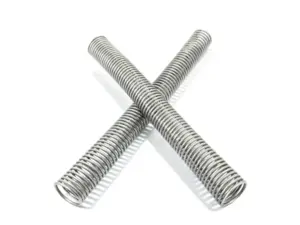
FeCrAl wire tends to win where the element must run hot and stay put: high-temperature resistance furnaces and kilns, radiant heating tubes, ceramic-supported elements in industrial ovens, and appliance heaters working at high surface load. Its resistivity advantage is also why it dominates compact, high-power elements built into small packages.
NiCr is preferred where the wire must survive handling and repeated cycling. That includes sheathed tubular elements — the coil packed inside a metal tube with magnesium oxide — chamber and laboratory furnaces that cycle often, appliance elements wound on automated machinery, and any design where repairability or flexing life matters more than peak temperature.
A Practical Selection Checklist
Before comparing resistance wire datasheets, settle these six points. They narrow the choice faster than any single property value.
Element temperature, not furnace temperature. The wire runs hotter than the load it heats, often by a wide margin.
Atmosphere. Air, wet air, sulfur-bearing gas, carbon-rich gas and vacuum each change the oxide’s behavior.
Cycling pattern. Continuous duty favors scale stability; frequent on-off cycles favor ductility and scale adhesion.
Surface load and wire diameter. A thin wire at high surface load oxidizes through far sooner than a thick one.
Support and geometry. Long unsupported spans punish low-creep-strength alloys.
Life-cycle cost. Purchase price per kilogram is the wrong metric; cost per operating hour is the right one.
One more variable is easy to overlook: the condition of the surface at the start of life. Every alloy above depends on growing its own protective oxide, and that process takes time and costs some element life at the beginning. A wire that arrives already oxidized starts further ahead.
A Pre-Oxidized Option: SPARK Golden Electric Heating Wire
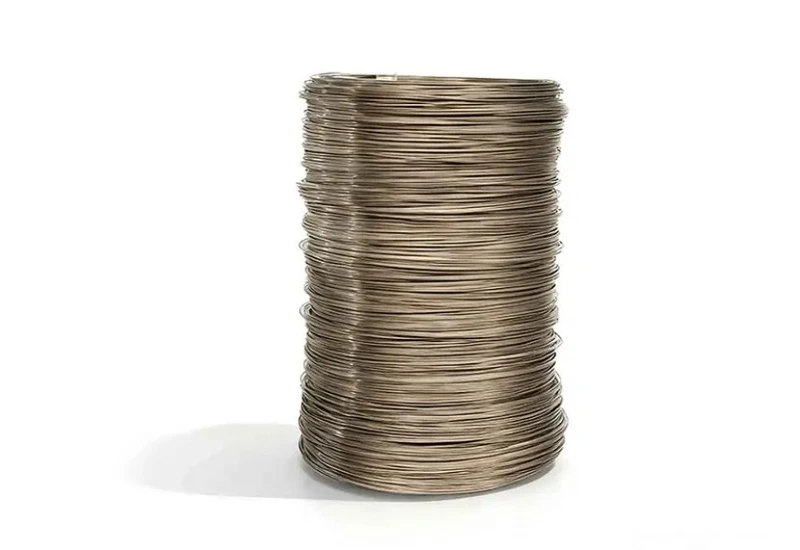
That is the idea behind SPARK Golden electric heating wire, a premium alloy product developed by Beijing Shougang Gitane New Materials Corporation through advanced heat treatment and precision machining. Unlike standard heating wires, this series goes through a specialized process that forms a thin, stable oxide film on the surface — the source of its distinctive cash yellow, or golden, appearance.
The finish is not cosmetic. It acts as a pre-protective layer that raises the alloy’s antioxidant performance and stability, and it is aimed at high-end applications where reliable thermal performance and a clean, durable surface are both required. The range is available on either base covered above: Fe-Cr-Al or Ni-Cr.
Product Features
- Enhanced antioxidant protection — the golden oxide film works as a barrier, limiting further oxidation and extending service life at high temperature.
- Clean, aesthetic surface — the smooth golden finish suits applications where component appearance and surface cleanliness are critical.
- High strength and toughness — mechanical integrity holds up under thermal stress, reducing the risk of deformation or brittleness.
- Stable resistance — precision manufacturing keeps resistance consistent along the wire, preventing local hot spots.
- Good processability — despite the pre-formed oxide layer, the wire stays flexible enough for winding and shaping into various heater configurations.
Technical Parameters
| Parameter | Specification and Performance |
| Product Brand | SPARK |
| Material Base | High-quality electric heating alloy (Fe-Cr-Al / Ni-Cr) |
| Surface Finish | Golden (cash yellow) oxide film |
| Common Diameter Range | 2.0 mm – 10.0 mm (fully customizable) |
| Core Characteristics | High strength, superior toughness, antioxidant |
| Production Process | Precision smelting plus special heat treatment |
| Shape Stability | Excellent (minimized thermal deformation) |
Available Specifications
| Form | Dimensional Details |
| Wire Diameter | 2.0 mm – 10.0 mm standard range; other sizes on request |
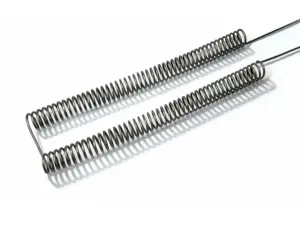
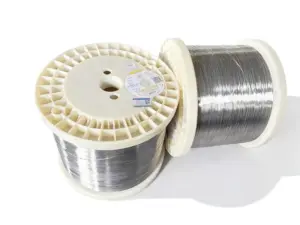
| Shapes Available | Straight wire, spooled wire, pre-wound coils (spirals) |
| Surface Options | Golden (pre-oxidized), bright, or black |
| Customization | Full adjustment of shape, length and resistance |
Application Fields
SPARK Golden finished products are used across several demanding sectors:
- Industrial heating — resistance furnaces, industrial baking equipment and high-temperature ovens.
- Household appliances — premium heating elements for electric kettles, rice cookers and high-end heaters.
- Automotive components — headlights, seat heaters and sensor heating units.
- Customized engineering — high-temperature or anti-oxidation components designed for a customer’s specific thermal environment.
Technical Support and Packaging
- Custom geometric shapes — coils, zig-zags or straight runs, adjusted to suit the machinery.
- Material design — for specific parameters or harsh service conditions, the technical team designs a matching alloy ratio and pre-oxidation protocol.
- Quality assurance — every batch is checked for surface uniformity and resistance consistency.
- Packaging — plastic or foam protection in wooden cases, with optional iron plate reinforcement for long-distance international shipping.
Why GITANE
- Brand reputation — SPARK is produced by Gitane, a specialist manufacturer with more than70 years of metallurgical history.
- Advanced metallurgy — backed by Shougang Group for raw material purity and smelting technology.
- Innovation focus — expertise in special surface treatments, such as the golden finish, that push performance beyond standard specifications.
- Global reach — trusted by high-end manufacturers in North America, Europe and Southeast Asia.
Conclusion
Neither alloy is simply better. FeCrAl wins on temperature ceiling, resistivity and sulfur tolerance; NiCr wins on ductility, hot strength and reworkability. Matching one to the other is a matter of reading the duty cycle honestly — element temperature, atmosphere, cycling pattern and support — rather than defaulting to whichever grade is already in the storeroom.
Surface condition adds a third variable that is often ignored. A pre-oxidized resistance wire starts life with the protective layer already in place, which can matter as much as chemistry when the element has to look clean and last long. If you are weighing grades for a specific heating element, the operating temperature, atmosphere, wire diameter and expected service life are enough to narrow the choice quickly. Considering heating wire for your application? Contact SPARK to find the right Fe-Cr-Al or Ni-Cr alloy solution for your needs.
FAQs
Is FeCrAl always the higher-temperature choice?
For continuous service in air, yes — alumina is a better barrier than chromia, so FeCrAl grades tolerate higher element temperatures. In sulfur-bearing or contaminated atmospheres the gap narrows, and a NiCr grade can outlast a higher-rated FeCrAl element that oxidizes prematurely.
Why does NiCr sometimes last longer in a lightly loaded oven?
Because life is not only about temperature. Frequent cycling, mechanical vibration and handling all favor ductility, and NiCr tolerates that abuse far better than a ferritic wire that has gone brittle.
Can the two alloys be swapped without redesigning the element?
No. Resistivity differs, so the same wire length and diameter will not deliver the same power. A swap means recalculating wire length, diameter and surface load — otherwise the element either underperforms or overheats.