Calculate nichrome wire resistance with R = ρL/A, using the selected grade’s resistivity, wire length, and cross-sectional area at a stated temperature. For hot resistance, apply the grade’s temperature factor: Rhot = Ct × R20.
One metre of wire does not have a single universal resistance. Change its diameter, grade, or temperature and the answer can change. This guide shows how to calculate cold and hot ohms, convert chart units, and check why a meter reading differs from the expected value.
Key Takeaways
- Resistance belongs to a defined length and section; resistivity is a material property.
- Keep the grade, units, and reference temperature beside every value.
- Doubling round-wire diameter reduces resistance to one-quarter when length, material, and temperature stay fixed.
- Ct is a temperature factor, not a coefficient expressed per degree.
- A resistance calculation does not prove the wire’s final operating temperature or an element’s suitability.
Nichrome Wire Resistance vs. Resistivity
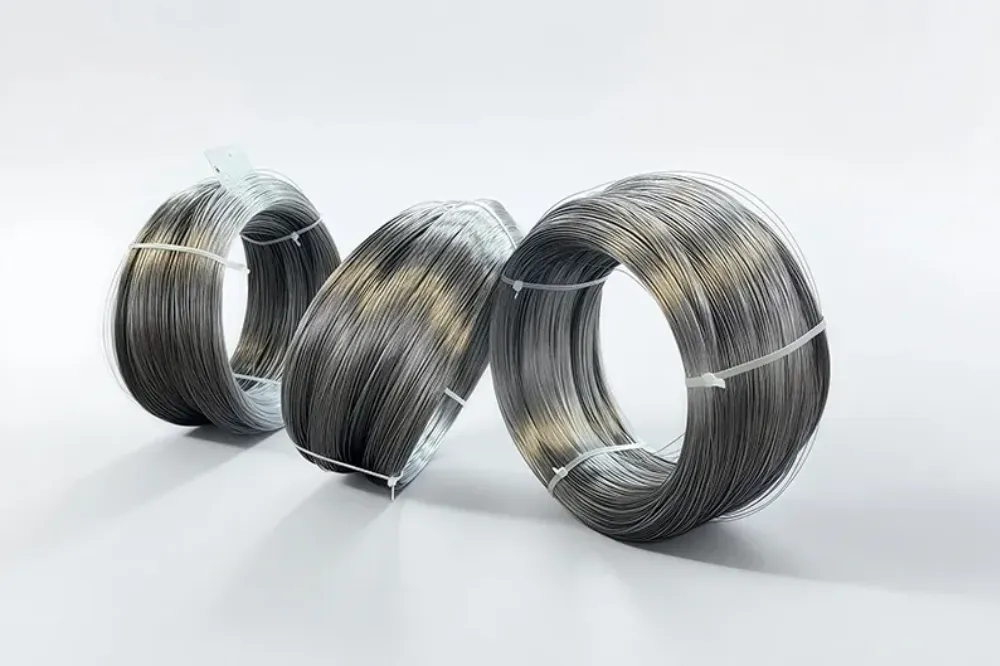
Resistance, R, describes a particular piece of wire and is measured in ohms (Ω). Resistivity, ρ, describes the material at a stated temperature. The two quantities are related, but they are not interchangeable.
For nichrome wire resistance calculations, the useful question is specific: what grade, diameter, length, and temperature does the value describe? A material name alone leaves too much unknown. NiCr alloys can have different electrical data even when they serve similar heating tasks.
Choose One Consistent Set of Units
A convenient resistivity unit for wire work is Ω·mm²/m. With that unit, enter length in metres and cross-sectional area in mm². The formula then gives resistance in Ω without another scale factor.
| Quantity | Symbol | Unit Used Here |
|---|---|---|
| Resistance of the sample | R | Ω |
| Material resistivity | ρ | Ω·mm²/m |
| Active wire length | L | m |
| Cross-sectional area | A | mm² |
| Round-wire diameter | d | mm |
Resistivity may also appear in μΩ·m. Numerically, 1 μΩ·m equals 1 Ω·mm²/m. Do not confuse either material unit with Ω/m, which is resistance per unit length for a particular wire section.
Use the NiCr grade selection guide when the material itself has not been chosen. This page focuses on calculating and checking resistance after the relevant inputs are defined.
Illustrative Scenario: A Value Without a Diameter
A buyer receives an offer stating “nichrome wire resistance: 5.5 Ω/m.” The quote does not list the grade or diameter. The value cannot yet be compared with the drawing because it lacks the conditions that define it.
The buyer should request the material, dimensions, and reference temperature. This illustrative scenario is a purchasing example, not a real customer case or a measured result.
If your drawing is incomplete, send SPARK the known resistance target and wire details. Identify the missing inputs so the discussion can address them directly.
How to Calculate Nichrome Wire Resistance
Start with the cross-sectional area. Then use the grade’s resistivity at the reference temperature and the actual wire length. This order keeps the geometry and material data visible throughout the calculation.
Find the Cross-Sectional Area
For round wire:
A = πd²/4
For rectangular ribbon:
A = width × thickness
Use mm for each section dimension when resistivity is in Ω·mm²/m. For a 0.5 mm round wire, A is about 0.196350 mm². Keep more digits during calculation than you show in the final answer.
Calculate Resistance per Metre, Then Total Resistance
To calculate nichrome wire resistance per metre, use r = ρ/A. Total resistance is R = rL. The lowercase r used here is a label for resistance per metre, not a second material property.
SPARK’s Cr20Ni80 technical table publishes ρ20 = 1.09 Ω·mm²/m. Using that value with 0.5 mm round wire gives r20 ≈ 5.551 Ω/m. A different grade or section needs a fresh calculation.
This is a calculated nominal value. It is not a batch measurement or an agreed tolerance for an order. State that distinction whenever a nichrome wire resistance table is based on formulas rather than test results.
Check What Changes When Dimensions Change
At fixed material, section, and temperature, resistance is proportional to length. Twice the length gives twice the resistance. Cutting the same wire to half its length gives half the resistance.
For round wire, area changes with the square of diameter. Twice the diameter gives four times the area and one-quarter of the resistance at the same length. If you instead hold resistance fixed, that thicker wire needs four times the length.
These are different comparisons. Do not use the fixed-length result to predict what happens in a redesigned coil that also changes length. Keep the unchanged variables written beside the calculation.
For the broader size decision, use the wire diameter and size guide. A nichrome wire resistance result is one input to that decision, not the complete design.
Read Resistance Charts and Convert Units
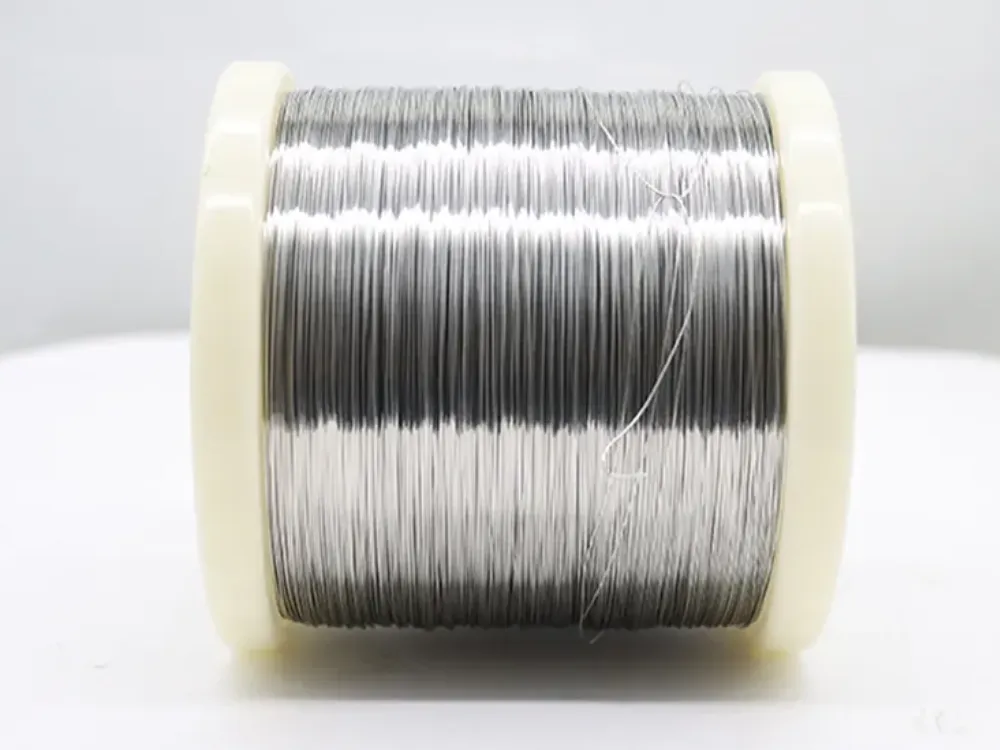
A nichrome wire resistance chart is useful only when its grade, section, and reference temperature match the question. Check whether the values describe a metre, a foot, a cut length, or a complete element. Also distinguish nominal supplier data from your own measurements.
A Small Calculated Metric Chart
The table below uses Cr20Ni80 resistivity of 1.09 Ω·mm²/m at 20°C. Each value comes from A = πd²/4 and r = ρ/A. These are calculations for nominal metric diameters, not measured stock values.
| Round Diameter, mm | Area, mm² | Calculated Resistance at 20°C, Ω/m |
|---|---|---|
| 0.25 | 0.049087 | 22.205 |
| 0.50 | 0.196350 | 5.551 |
| 1.00 | 0.785398 | 1.388 |
This nichrome wire resistance chart shows why a diameter must accompany an Ω/m value. It also provides a quick check on the square relationship: doubling diameter reduces the listed resistance per metre to one-quarter.
Convert Ohms per Foot and Ohms per Metre
One foot is exactly 0.3048 m. Therefore:
- Ω/m = Ω/ft ÷ 0.3048
- Ω/ft = Ω/m × 0.3048
For example, Remington Industries’ current Nichrome 80 data sheet lists 1.6089 Ω/ft for 24 AWG at 20°C. That converts to about 5.2785 Ω/m. The conversion changes the unit, not the material or the reference temperature.
Do not expect that value to equal the calculated result for an exact 0.5 mm Gitane wire. The supplier, nominal dimensions, and underlying material data differ. A near AWG equivalent is not an exact metric diameter.
Check the Version and the Trend
Remington’s PDF records an August 13, 2026 revision and lists 1.0155 Ω/ft for 22 AWG. Cached charts may contain earlier values. Consult the current source and the actual order requirements when comparing nichrome wire resistance data.
As a basic consistency check, thinner round wire of the same material and temperature should have more resistance per unit length. If a table reverses that trend, verify the row labels, units, grade, and source before using it. Do not silently correct a supplier table and present the result as certified data.
Use this unit check before comparing a calculated nichrome wire resistance with a catalog value:
| Possible Mix-Up | What to Check |
|---|---|
| Radius entered as diameter | The round-wire formula here requires the full diameter. |
| Millimetres mixed with metres | Keep section dimensions in mm and length in m for Ω·mm²/m. |
| Ω/ft read as Ω/m | Apply the length-unit conversion before comparing values. |
| Wire diameter replaced by coil diameter | Use the section of the conductive wire, not its wound shape. |
A correct formula cannot fix an incorrect input. Keep the original units on the calculation sheet so another person can check the conversion.
Nichrome Wire Resistance at Operating Temperature
Cold resistance and hot resistance can differ. Use a temperature factor for the selected grade and the intended reference conditions. Do not take a factor from another alloy just because the room-temperature resistivities look close.
Apply Ct in the Correct Direction
For the values used here, Ct relates resistance at the stated temperature to resistance at 20°C:
Rhot = Ct × R20
R20 = Rhot/Ct
SPARK’s Cr20Ni80 table gives Ct = 1.04 at 800°C. Its Cr15Ni60 table gives Ct = 1.08 at 800°C, with ρ20 = 1.11 Ω·mm²/m. Keep each grade’s resistivity and factor together.
The different factors mean that the same hot resistance target can require different cold targets. They also show why a single universal number cannot describe nichrome wire resistance over every grade and temperature.
Ct Is Not the Same as a Constant α
A linear model may be written as R(T) = R0[1 + α(T − T0)]. In that model, α is a coefficient per degree over an applicable range. Ct, by contrast, is a dimensionless factor at a stated temperature.
Do not insert Ct = 1.04 into the formula as though it were α. Do not assume a constant α is valid across the full heater temperature range. Use the grade’s published data and the method agreed for the design.
For comparison, Kanthal’s Nikrothal 80 data sheet lists temperature factors, including 1.05 at 1000°C. That is a data-format example for its branded material, not proof that all Ni80 wires share every property.
Resistance Does Not Set the Final Temperature
A calculated hot value assumes a specified thermal condition. It does not establish that applying a given voltage will produce that temperature. The final temperature depends on the heat balance and the element’s surroundings.
For nichrome wire resistance work, separate the electrical calculation from the thermal review. Wire support, spacing, atmosphere, duty, and heat transfer still matter. An arithmetic match is not approval of an element’s operating limits.
Worked Examples: From Wire Length to Heater Target
Illustrative Scenario: Check Two Electrical Questions
An engineer needs to answer two questions: what resistance should a known sample have, and what cold target corresponds to a proposed heater load? The examples below use stated assumptions so the steps can be checked. They are teaching calculations, not measured customer results.
Example 1: A Two-Metre Sample
Assume uniform round Cr20Ni80 wire, diameter 0.5 mm, length 2 m, and resistivity 1.09 Ω·mm²/m at 20°C. Cross-sectional area is 0.19634954 mm². Resistance per metre is 1.09/0.19634954 ≈ 5.551324 Ω/m.
The calculated cold resistance is:
R20 = 5.551324 × 2 ≈ 11.102649 Ω
If a separate design assumption places that wire at 800°C, use Ct = 1.04:
Rhot = 11.102649 × 1.04 ≈ 11.546755 Ω
The nichrome wire resistance result is about 11.103 Ω cold and 11.547 Ω at the assumed hot condition. It does not state how much power is needed to hold 800°C. That question requires the actual thermal arrangement.
Example 2: A 24 V, 48 W Target
Assume 24 V across one resistive element and 48 W at its intended operating condition. The target hot resistance is Rhot = V²/P = 24²/48 = 12 Ω. For an AC resistive calculation, use the appropriate RMS voltage across the element.
If the selected material is Cr20Ni80 and the assumed wire temperature is 800°C, R20 = 12/1.04 ≈ 11.538462 Ω. Using the same exact 0.5 mm candidate, required active length is 11.538462/5.551324 ≈ 2.078506 m.
| Calculation | Result |
|---|---|
| Target operating resistance | 12 Ω |
| Cold target at 20°C | 11.538462 Ω |
| Candidate diameter | 0.5 mm |
| Calculated active wire length | 2.078506 m |
For Cr15Ni60 at the same assumed temperature, Ct = 1.08 would give a different cold target: 12/1.08 ≈ 11.111111 Ω. Its different resistivity also changes the length for a chosen section. Recalculate both rather than changing only the grade name.
This reverse nichrome wire resistance calculation defines an electrical candidate. Check active length, tails, connections, mounting space, and heat transfer before finalizing a drawing. Do not round the length early and then claim an exact resistance match.
Measure and Specify the Resistance You Need
When the reading differs from the calculation, first check whether the same quantity is being compared. Sample length, temperature, dimensions, and included connections all affect the comparison. A nichrome wire resistance mismatch does not by itself prove the material is wrong.
Define the Cold Test
Record the grade, test length, test temperature, instrument, and connection method. Specify whether the value concerns raw wire or the finished assembly. If the nominal target is at 20°C, do not compare it without review to a reading taken from warm wire.
For a nichrome wire resistance test, define which points establish the measured length. Include or exclude terminals consistently. Agree the acceptable range with the supplier instead of treating a rounded calculation as a guaranteed tolerance.
Lead Resistance and Four-Wire Measurement
Tektronix/Keithley’s low-resistance measurement whitepaper explains how test leads can affect a two-wire reading and how a four-wire method separates current and voltage-sense connections. The method can reduce lead-related error; it does not remove every source of measurement error.
Contact conditions, thermal effects, instrument limits, and test current still need attention. Use an appropriate test method and account for self-heating. Measure resistance on an isolated, de-energized part using the instrument’s instructions.
Illustrative Scenario: Two Benches, Two Readings
Two inspectors check the same wire but use different contact points and sample lengths. One measures the wire section alone; the other includes connecting sections. Their readings cannot be judged against one target until those test conditions match.
This illustrative scenario highlights a common comparison problem without inventing readings or test data. A useful nichrome wire resistance record describes the setup, not just the displayed ohms.
Write a Test Record Before Comparing Results
A nichrome wire resistance check should leave a record that someone else can repeat. Use the following fields for the sample or assembly under review. The acceptance range must come from the agreed order, not from this example.
| Record Field | What to Enter |
|---|---|
| Material identity | Grade and the relevant lot or sample reference |
| Measured section | Wire diameter, or ribbon width and thickness |
| Length definition | Distance between the stated test points |
| Thermal condition | Reference temperature and actual test temperature |
| Electrical method | Instrument, range, test current, and connection method |
| Result and acceptance | Reading, agreed limits, and any corrections applied |
If a result is outside the agreed range, first check the setup and the stated conditions. Then compare the measured sample with the material and dimensional requirements. Do not alter the calculation merely to make it match a reading.
For finished assemblies, keep the same boundary around the nichrome wire resistance measurement each time. A reading that includes connecting tails cannot be compared directly with a target defined for the active wire alone.
Frequently Asked Questions
What Is the Resistance of One Metre of Nichrome Wire?
There is no single value. Nichrome wire resistance per meter depends on grade, cross-sectional area, and temperature. For the stated 0.5 mm Cr20Ni80 example at 20°C, the calculated nominal value is about 5.551 Ω/m.
How Do I Calculate the Length for a Resistance Target?
For a nichrome wire resistance target, first state whether it is cold or hot. Convert it to the reference temperature used by the resistivity data, then use L = RA/ρ. Keep the units consistent and check the resulting length against the assembly drawing.
Why Do Two Charts Give Different Numbers?
Check grade, nominal diameter, reference temperature, units, and source version. Some tables list supplier nominal values; others show calculated values. A nichrome wire resistance comparison needs matching conditions before a difference can be interpreted.
Does Winding the Wire Into a Coil Change Its Length?
The active wire length is the length of the conductive path, not the finished coil’s overall length. Use the actual wire dimensions after processing. Do not substitute the coil’s outer diameter or installed span for the section and length in R = ρL/A.
Can I Use a Resistance Calculator as the Final Design?
A calculator can perform the arithmetic, but its inputs and assumptions must match the material and device. It does not confirm allowable temperature, support, atmosphere, or acceptance tolerance. This article provides a calculation method, not an approved heater design.
What Should I Confirm Before Ordering?
Keep the grade, dimensions, cold resistance, reference temperature, and test method with the drawing. State the electrical target and operating conditions separately. That record makes nichrome wire resistance calculations useful to engineering, purchasing, and inspection.
For a technical quotation, send SPARK your material requirements and element drawing. A clear nichrome wire resistance target, with its units and conditions, gives the next discussion a defined starting point.