In the realm of advanced thermal processing, the reliability of heating elements defines production yield, energy efficiency, and maintenance costs. Engineers have long recognized that conventional resistance wire can struggle beyond 1300°C, especially in aggressive carburizing atmospheres or under heavy thermal cycling. The question then becomes: is there a high temperature heating wire that can push the continuous service ceiling while maintaining form stability and corrosion resistance? The SGHT series, an oxide dispersion strengthened (ODS) FeCrAl alloy, provides a data-backed answer. This article examines its metallurgical uniqueness, quantifiable advantages, and real-world application performance to help you decide whether SGHT belongs in your next heat treatment furnace design.
What Is SGHT Super electric heating alloy? A Definition
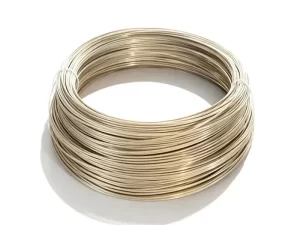
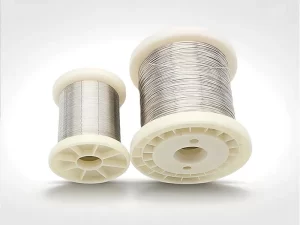
SGHT is an ODS ferritic iron-chromium-aluminum (FeCrAl) alloy produced through advanced powder metallurgy. Unlike conventionally melted and cast FeCrAl resistance wire, SGHT incorporates ultrafine yttrium-based oxide particles that are mechanically alloyed into the metal matrix. These nano-scale dispersoids remain stable even above 1300°C, pinning grain boundaries and impeding dislocation movement. The result is a material that retains creep strength and sag resistance at temperatures where standard FeCrAl alloys would rapidly soften. Manufacturing involves high-energy milling of pre-alloyed powder, followed by hot isostatic pressing and hot extrusion into wire or tube form, yielding a microstructure with an inclusion rating below 3.5 and remarkably few inclusions larger than 3.0 µm.
Key Specifications and Measured Performance
The SGHT data sheet quantifies performance in ways that matter for industrial furnace heating elements:
- Maximum continuous operating temperature: 1425°C (Its temperature resistance is higher than the 1400 ℃ temperature of the highest iron chromium aluminum product “SGHYZ” manufactured under traditional processes)
- Room temperature tensile strength: 650–750 MPa
- Elongation: 15%–30%
- Hardness: 220–260 HV
- Resistivity: 1.38–1.45 µΩ·m
- Creep resistance: Collapse sag ≤ 2 mm after 150 hours at 1300°C
- Certification: CE compliance
These figures position SGHT as a direct upgrade for any heat treatment furnace where element deformation is the primary failure mode.
The Unique Advantages: ODS Metallurgy at Work
Traditional FeCrAl resistance wire relies on a protective alumina scale for oxidation resistance, but at extreme temperatures grain growth weakens the alloy and leads to sagging. In SGHT, the ODS mechanism creates three distinct competitive advantages:
1. Higher thermal stability: Ultrafine oxide dispersoids maintain a fine grain structure, allowing a maximum service temperature of 1425°C. This is significant because the well-documented Kanthal APM FeCrAl alloy is rated for a continuous operating temperature of 1425°C as well, but SGHT achieves this while offering superior hot strength in sulfur- and carbon-rich environments that rapidly degrade conventional grades. [Data source: Kanthal® APM resistance heating wire datasheet]
2. Enhanced creep and sag resistance: The oxide particles act as barriers to dislocation climb. At 1300°C for 150 hours, SGHT wire exhibits a sag of ≤ 2 mm, which directly translates into longer spans between supports and reduced support material cost. This also allows a higher surface load design, enabling more compact industrial furnace heating elements.
3. Extended service life and cost efficiency: Furnace bodies designed with SGHT alloy show a 50% longer service life compared to those using common FeCrAl alloys, according to manufacturer data. For furnace operators, this means fewer shutdowns, lower replacement labor, and improved production continuity.
| Property / Feature | SGHT (ODS FeCrAl) | Conventional FeCrAl (e.g., 0Cr25Al5) |
| Max. continuous temperature | 1425°C | 1300°C |
| 1300°C sag resistance (150h) | ≤ 2 mm | Noticeable sag, requires frequent support |
| Carburizing atmosphere stability | Excellent (alumina scale) | Moderate overall; resistant at medium temps, but brittle at high-temp carburization. |
| Inclusion cleanliness | <3.5 rating, very few >3.0 µm | Conventional casting; coarse inclusions are common, moderate cleanliness. |
| Typical life improvement in furnace | Up to 50% longer | Baseline |
Production Process: Step-by-Step Manufacturing of SGHT
Understanding how the high temperature heating wire achieves its properties requires a look at the powder metallurgy route. The process steps are critical to the dispersion quality:
Step 1 – Powder blending and mechanical alloying: Pre-alloyed FeCrAl powder is mixed with a precisely controlled amount of yttrium oxide (Y₂O₃) and intensively milled under a protective atmosphere. This high-energy milling embeds nanoscale oxide particles uniformly into each powder particle.
Step 2 – Canning and degassing: The mechanically alloyed powder is sealed into a mild steel can, which is then evacuated and heated to remove adsorbed gases. This step is vital to prevent oxygen pickup that would otherwise form harmful larger oxide clusters.
Step 3 – Hot isostatic pressing (HIP): The canned powder is subjected to high temperature and isostatic gas pressure, consolidating it into a fully dense billet without melting. HIP preserves the ultrafine dispersoids that would dissolve in conventional melting.
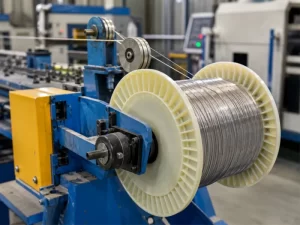
Step 4 – Hot extrusion and working: The billet is heated and extruded into rod, wire, or tube, followed by controlled hot rolling or drawing. This thermomechanical processing develops the anisotropic grain structure that further enhances creep resistance in the loading direction.
Step 5 – Surface finishing and inspection: The final wire or tube is descaled, pickled if needed, and inspected for dimensional tolerances and surface flaws. The ODS alloy’s inherently low inclusion count simplifies final quality assurance.
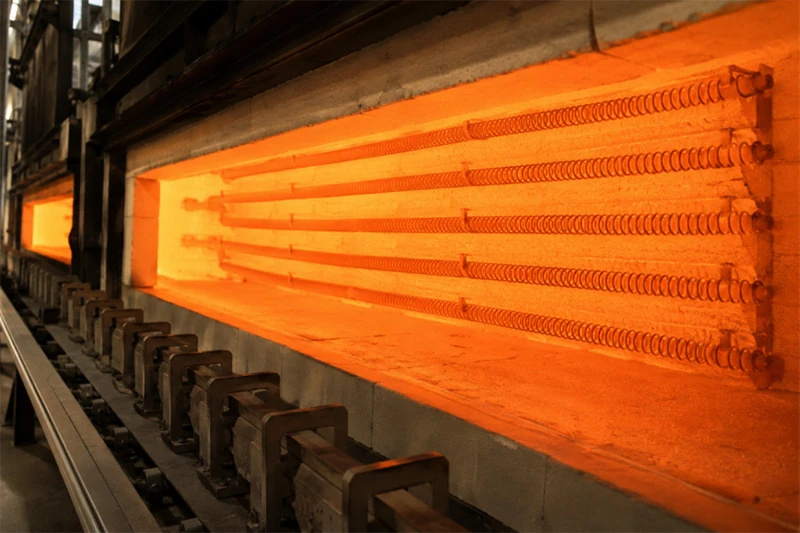
Primary Application Scenarios
1. Semiconductor Diffusion Furnaces: SGHT Wire
In an 8-inch wafer vertical diffusion furnace, the heating element must sustain >1200°C with absolute temperature uniformity and zero particle shedding. One semiconductor fabricator found that conventional heating wire deformed and sagged after short service periods, causing temperature drift that impaired doping uniformity. By switching to SGHT wire manufactured by a specialized heating element manufacturer, the problem was resolved: the ODS microstructure prevented creep-induced sag, maintaining strict thermal profiles. The result was a significant reduction in unscheduled downtime and improved wafer yield, with the element exhibiting minimal distortion after thousands of hours.
2. High-Temperature Carburizing Radiant Tubes: SGHT Tube
A carburizing furnace used for case hardening gears operated with radiant tubes at 950°C in endothermic gas. The original 310S stainless steel tubes suffered rapid oxide scale spallation and carburization-induced embrittlement, failing within months. Replacing them with SGHT tubes, produced via hot extrusion of the ODS powder metallurgy material, transformed reliability. The dense, adherent alumina scale that forms on SGHT’s surface provides exceptional resistance to both oxidation and carbon diffusion. The tubes now endure higher power density without distortion, enabling faster heating cycles. The engineering team from the heating element manufacturer calculated a life extension exceeding 50% compared to the previous stainless steel design, while also reducing energy losses from degraded tube surfaces.
3. High-Performance Ceramic Sintering and R&D Furnaces
For sintered ceramics, SGHT wire can provide clean and stable heating effect, and the furnace maintenance requirements are extremely low. Both research laboratories using high-temperature muffles and tube furnaces can benefit from their precise temperature control and long-term shape stability, which are crucial for reproducible material testing.
4. Photovoltaic Wafer Processing
With large-size silicon wafers requiring homogeneous high-temperature steps, SGHT’s ability to maintain element geometry under thermal cycling directly supports the uniformity demands of photovoltaic diffusion and oxidation processes.
Frequently Asked Questions (FAQ)
Q1: What makes SGHT different from standard FeCrAl alloy wire?
A1: SGHT is an oxide dispersion strengthened alloy manufactured via powder metallurgy rather than conventional melt-casting. The ultrafine oxide particles inhibit grain growth and dislocation motion, providing superior hot strength and sag resistance. While a conventional wire may soften and sag at 1300°C, SGHT maintains its shape with less than 2 mm deflection under the same conditions.
Q2: Can SGHT be used as a direct replacement for 310S stainless steel radiant tubes?
A2: Yes, and it significantly outperforms 310S in carburizing atmospheres. Where 310S forms a chromium oxide scale that spalls and permits carbon ingress, SGHT develops a stable alumina layer that resists both oxidation and carburization. The higher hot strength also allows a thinner wall or a higher power density design, improving thermal efficiency.
Q3: What is the maximum operating temperature of SGHT wire?
A3: The alloy is rated for continuous use up to 1425°C in oxidizing atmospheres. This upper bound matches advanced ODS FeCrAl materials, such as Kanthal APM, but SGHT’s proprietary powder metallurgy process ensures the same temperature capability while offering enhanced performance in sulfur- or carbon-bearing environments that accelerate the degradation of many grades. [Data source: Kanthal® APM resistance heating wire datasheet]
Q4: How does the inclusion cleanliness affect the service life of furnace heating elements?
A4: Low inclusion content directly correlates with reduced crack initiation and more uniform electrical resistance. With an inclusion rating below 3.5 and minimal inclusions above 3.0 µm, SGHT wire maintains consistent cross-sectional area and avoids hot spots that can lead to premature failure.
Q5: Is SGHT available in both wire and tube forms?
A5: Yes. SGHT wire is typically used for coiled or straight heating elements in ceramic kilns, semiconductor furnaces, and laboratory equipment, while SGHT tube is designed for radiant tubes and protective sheaths in corrosive high-temperature environments. Both forms leverage the same ODS microstructure.
Conclusion
When a furnace demands long-term dimensional stability at extreme temperatures, the resistance wire you select determines both operational uptime and total cost of ownership. SGHT Super electric heating alloy, produced through a tightly controlled powder metallurgy route, delivers quantifiable gains: a 50% increase in furnace body lifetime, sag of ≤2 mm after prolonged exposure at 1300°C, and compatibility with carburizing and corrosive atmospheres that destroy conventional materials. Whether for semiconductor wafer processing or high-throughput carburizing radiant tubes, SGHT wire and tube provide the engineering confidence that a specialized heating element manufacturer can supply. For continuous 24/7 operation, that confidence translates into higher production efficiency and measurably lower lifecycle costs.