Introduction
Global buyers often struggle to distinguish between Shougang Gitane’s three FeCrAl grades—HRE, SGHYZ, and SGHT—risking over-specification that wastes budget or under-specification that causes premature failure. As a leading resistance wire manufacturer, Shougang Gitane has progressed from high-purity melting through rare-earth modification to ODS powder metallurgy, with each alloy tier matching a specific thermal and mechanical load. Choosing wrongly can halt production and ruin entire batches, making material selection a critical engineering safeguard rather than just a purchasing decision. Spark Heating, as an integration partner, turns these advanced materials into reliable industrial heating element systems, delivering fully engineered heating assemblies designed for each customer’s unique process conditions.
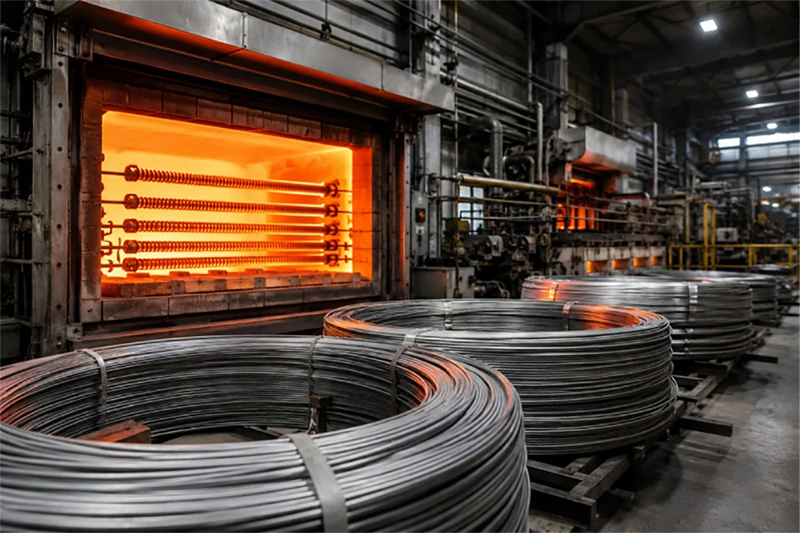
Core Parameter and Cost-Performance Comparison
The table below summarizes the technical and commercial positioning of the three grades side by side. It is designed to give engineers a quick, data-driven reference when evaluating materials for demanding high-temperature environments.
| Comparison Dimension | HRE | SGHYZ | SGHT |
| Metallurgical Process | Conventional High-Purity Melting | Rare-Earth Modified Melting | Advanced ODS Powder Metallurgy |
| Maximum Operating Temperature | 1350°C | 1400°C | 1425°C |
| Anti-Sag & Creep Resistance | Standard (1300°C collapse test ~31 mm) | Good (Dense alumina protective scale) | Excellent (≤2 mm sag at 1300°C/150 h) |
| Room Temperature Tensile Strength | 680 MPa | Superior to standard grades | 650 – 750 MPa |
| Key Certifications | ISO, CE, REACH-ROHS/SVHC | CE, REACH-ROHS/SVHC | CE, REACH-ROHS/SVHC |
| Relative Cost & ROI | Highly cost-effective; approx. 400 CNY/kg cost reduction vs. imports | Balanced cost-performance; service life often doubled | Higher initial cost; furnace service life extended by 50% |
SGHT: The ODS Alloy for Extreme Thermal Demands
When an operating point pushes past the limits of conventional FeCrAl alloy heating wire, SGHT provides a true step-change through oxide dispersion strengthening. Produced by an advanced powder metallurgy route, the material contains an exceptionally low density of non-metallic inclusions—inclusions above 3.0 μm are rare, and the overall inclusion rating stays below Class 3.5. The ultra-fine oxide particles uniformly dispersed in the matrix block grain boundary sliding and hinder dislocation motion well into the 1100–1300°C range. Physical properties include room-temperature tensile strength of 650–750 MPa, elongation of 15–30%, hardness of 220–260 HV, and electrical resistivity of 1.38–1.45 μΩ·m.
In semiconductor manufacturing, an 8-inch wafer vertical heat treatment furnace needed a solution capable of continuous operation above 1200°C. The original FeCrAl elements sagged and deformed rapidly, producing temperature non-uniformity and releasing impurities that lowered wafer yield. Once replaced with SGHT wire, the enhanced creep resistance kept the thermal field precise over long production runs, sharply reducing unscheduled downtime and protecting cleanroom integrity.
A different challenge appeared in a carburizing heat treatment furnace where radiant tubes operate above 950°C in carbon-rich atmospheres. Conventional 310S stainless steel tubes suffered from oxide scale spallation and early carburization failure. SGHT tubes, made by hot extrusion integrated forming, develop a stable, dense alumina protective layer. This dramatically raises resistance to carburization and allows the tube to handle higher power densities without compromising service stability, directly enabling higher throughput in precision heat treating.
SGHYZ: The Rare-Earth Modified Workhorse
SGHYZ sits in the middle of the portfolio, engineered for applications where surface stability and cleanliness are paramount. Through high-purity melting combined with rare-earth micro-alloying, the alloy quickly forms a dense, tenacious alumina (Al₂O₃) protective film at operating temperature. This fundamentally suppresses the oxide spallation that often limits element life in sensitive thermal processes.
A large photovoltaic monocrystalline silicon producer ran diffusion furnaces continuously at 1050–1250°C and struggled with yield loss caused by the standard FeCrAl alloy heating wire. It oxidized and shed debris onto wafers, creating spot defects, color variation, and lower cell conversion efficiency. Frequent sagging forced a full element change every three months. After switching to SGHYZ rare-earth modified wire, the dense protective scale stopped flaking entirely. The replacement cycle extended to over six months, halving maintenance shutdowns and markedly lowering annual operating costs while stabilizing high-volume wafer output.
In semiconductor ALD and CVD thin-film deposition tools, the heating module operates in a vacuum and inert gas environment where material outgassing can contaminate the chamber. Domestic alternatives to costly imported elements often released volatile impurities, leading to uneven film thickness and reduced chip yield. SGHYZ semiconductor-grade wire, with ultra-low outgassing characteristics and low outgassing and high-cleanliness characteristics, enabled precise temperature control without chamber contamination, improving film uniformity and achieving a successful domestic substitution.
High-end automotive glass tempering furnaces present a third scenario. Operating 24/7 at 800–1100°C, the original wires oxidized, sagged, and dropped particles onto the glass surface, causing pits, scratches, and high rejection rates. Uneven thermal fields also produced stress imbalances in the finished glass. The full upgrade to SGHYZ wire eliminated surface defects, doubled the element service life, and cut maintenance downtime, delivering a synchronized improvement in product quality and operational profitability.
HRE: The High-Performance Baseline
HRE remains a robust and cost-effective benchmark among industrial heating element materials. With a maximum service temperature of 1350°C, a tensile strength of 680 MPa, and a rapid life test result of 85 hours at the same temperature—outperforming some comparable grades that reach only about 60 hours—it delivers reliable performance wherever conditions stay within standard limits.
The alloy fits naturally into a wide range of general thermal processing applications, from glass treating to metal annealing. Its 1000°C creep rupture strength of 2.20 MPa and proven oxidation resistance make it a sound choice when the operating environment does not demand the extreme capabilities of the higher alloy generations.
A photovoltaic silicon wafer diffusion and sintering furnace running at 1100°C originally used standard elements that lasted only six months. Temperature fluctuations reached ±25°C, energy consumption was high, and impurity precipitation held production yield at just 93%. Replacing them with HRE high-performance FeCrAl alloy heating wire optimized the thermal field and stabilized the resistance characteristics . Element lifetime extended to ten months, furnace temperature uniformity tightened to ±5°C, energy consumption dropped by 26%, and wafer yield rose to 99.2%, generating an annual cost saving of over 800,000 CNY.
Automotive glass annealing and bending kilns benefit from another HRE property. Its surface emissivity of approximately 0.7 promotes efficient radiative heat transfer, while its resistance to deformation under repeated cold–hot cycling maintains consistent glass quality. For any general thermal process that must balance performance with strict budget targets, HRE is the solid, field-proven starting point.
How to Select the Right Grade for Your Specific Process
The choice should always be driven by peak operating temperature, atmosphere cleanliness requirements, and the true cost of downtime. The following decision framework translates these factors into actionable guidance.
Scenario A – Standard High–Temperature & Cost-Effectiveness (1100–1300°C)
For automotive glass tempering, general metal heat treating, or ceramic sintering furnaces where elements can be replaced with moderate effort, HRE delivers the highest value. Its 1350°C ceiling and strong oxidation resistance cover the majority of conventional high–temperature furnace requirements without over-investment.
Scenario B – High Cleanliness & Oxidation Scale Prevention (800–1300°C)
When the process cannot tolerate any particle shedding—semiconductor CVD and ALD chambers, photovoltaic diffusion lines, or high-end display glass bending—SGHYZ is the appropriate selection. The rare-earth stabilized alumina scale prevents the flaking that causes product defects, while the improved hot strength extends maintenance intervals.
Scenario C – Ultimate Temperature & Creep Resistance (1300–1425°C)
For vertical semiconductor wafer furnaces, ultra-high-power-density carburizing heat treatment tubes, or any design requiring long unsupported spans at near-melting temperatures, SGHT ODS alloy is essential. The ≤2 mm sag at 1300°C over 150 hours allows designs with minimal support, maximizing payload and achieving the lowest total cost of ownership through dramatically longer service life.
As a reliable resistance wire manufacturer, Shougang Gitane provides data-driven material recommendations and custom-designed heating components. Please share your furnace type, operating temperature profile, atmosphere, and element geometry, and our thermal engineers will return a specific quotation for the right alloy in your industrial heating element configuration.
Frequently Asked Questions
Q: What is the core technical difference between SGHT and SGHYZ?
A: SGHT relies on oxide dispersion strengthening (ODS) via powder metallurgy, achieving superior creep resistance up to 1425°C. SGHYZ uses rare-earth micro-alloying in a high-purity melt process, prioritizing a tenacious, spallation-resistant alumina surface scale for clean processes below 1400°C.
Q: Can HRE alloy be used in a carburizing atmosphere?
A: HRE performs well in oxidizing and inert atmospheres up to 1350°C, but it is not specifically designed for strongly carburizing environments. For carbon-rich atmospheres at high-temperature, SGHT radiant tubes with their dense alumina scale offer much better resistance to carburization and metal dusting.
Q: How does Shougang Gitane’s ODS technology improve sag resistance?
A: The ODS process introduces ultra-fine, stable oxide particles uniformly dispersed in the alloy matrix. These particles block grain boundary sliding and dislocation movement at temperatures where conventional alloys soften, keeping the FeCrAl alloy heating wire dimensionally stable even near its maximum rated temperature.
Q: How quickly can a high-volume user see a return on the investment in SGHT?
A: Although the initial procurement cost is higher, field data shows that the service life of a furnace body designed with SGHT alloy is extended by 50%. When combined with reduced downtime, fewer element replacements, and consistent product quality, the overall cost of ownership typically turns positive within the first extended maintenance cycle.
Q: Is it possible to reduce element diameter by switching to SGHT?
A: Yes. Because SGHT permits a higher surface load design owing to its exceptional high-temperature strength and creep resistance, you can sometimes use a smaller wire diameter or thinner strip to deliver the same heat output. This can save materials and space inside the high-temperature furnace, but the exact redesign should be verified by a qualified electric heating engineer.