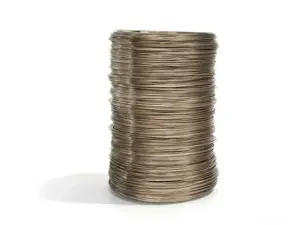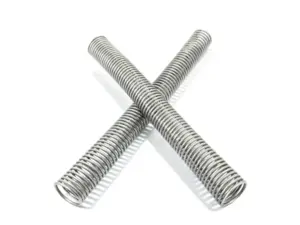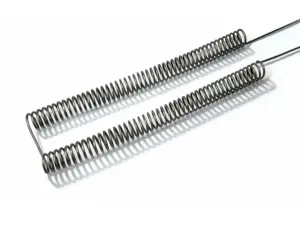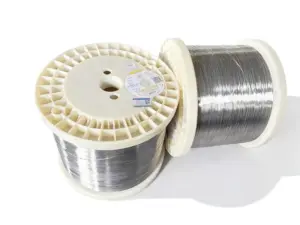
Nichrome ribbon is a flat nickel-chromium resistance material specified by alloy, width, thickness and electrical resistance. To select it, match those properties to the element layout, temperature, atmosphere and power supply.
A size that fits a drawing can still give the wrong resistance. A resistance that matches a cold test can still leave the designer with an unsuitable hot element. The useful starting point is a complete specification that connects the metal to its service conditions.
This guide explains how to compare flat and round forms, calculate a reference resistance, and prepare an enquiry. It also shows where simple calculations stop and application review begins.
Key Takeaways
- Specify width and thickness together; neither dimension defines the cross-sectional area alone.
- Use the named alloy’s resistivity and reference temperature when calculating resistance.
- Compare ribbon and round wire at equal area and length before drawing conclusions.
- Treat a material temperature rating as one input to element design, rather than a finished-heater guarantee.
- Include supports, terminals, atmosphere and duty cycle in the specification.
What Is Nichrome Ribbon?
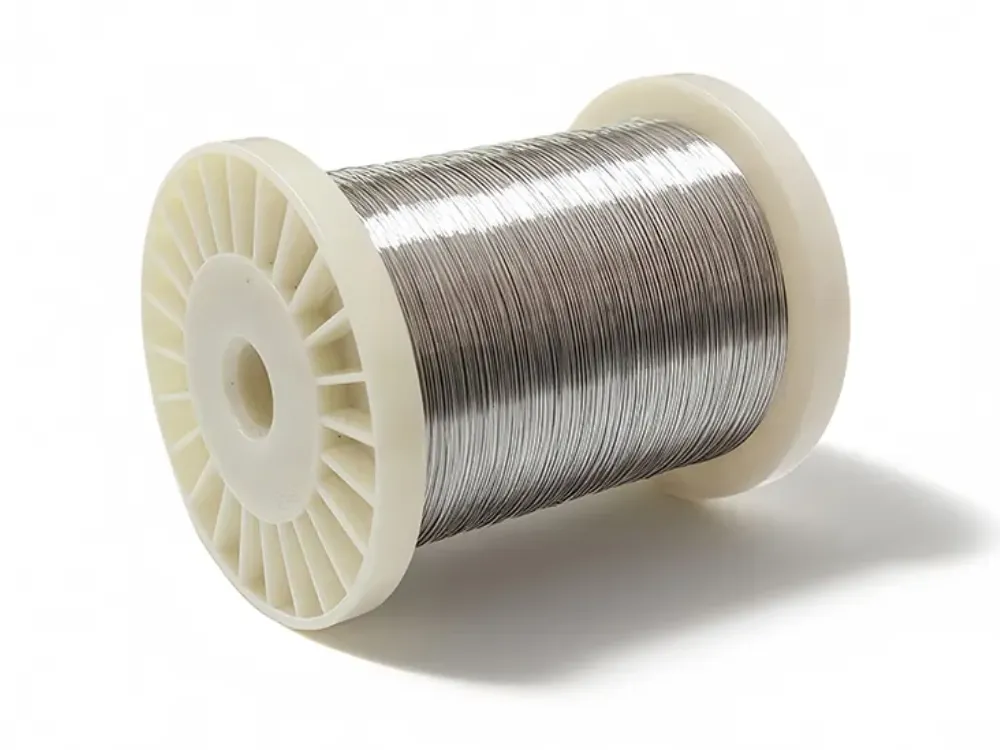
Ribbon, Strip and Flat Wire
Suppliers use ribbon, strip and flat wire to describe flat resistance materials. Those labels don’t replace a dimensional drawing. Ask what section, edge shape and supply condition the quoted product actually has.
For nichrome ribbon, the broad faces create a different layout from a round wire. The designer must consider the space between adjacent runs, how the element rests on a support, and where the ends connect. A nichrome ribbon catalogue name does not answer those questions.
Start with the nickel-chromium alloy selection guide if the material family is still undecided. This article focuses on the flat form and its specification.
Read Both Dimensions
Write dimensions in a defined order, such as width × thickness. Put units beside the values and use the same order on the drawing, enquiry and inspection record. This avoids treating two different sections as the same part.
For an ideal rectangle, cross-sectional area equals width multiplied by thickness. Real nichrome ribbon edge profiles can depart from that shape. Where exact resistance matters, use the supplier’s section data and resistance specification rather than relying only on nominal dimensions.
Illustrative Scenario: A Clearer Enquiry
A buyer requests “flat heating wire” for an existing assembly. The supplier cannot tell whether the buyer needs a narrow ribbon, a wider strip, or a particular resistance per metre. The buyer adds width, thickness, active length and a cold resistance record.
The revised enquiry gives both parties a basis for comparison. It does not establish a service life or qualify a substitute. That still requires the material and operating conditions.
If you are preparing a nichrome ribbon enquiry, send SPARK your drawing and service conditions. Include the requested alloy and resistance so the supply scope can be confirmed.
Choose the Alloy Before the Dimensions
Grade Names Need Supporting Data
A nichrome ribbon alloy label is a starting point. Request the material designation, composition reference, resistivity and supply condition for the product being offered. Do not assume that every flat material described as “80” or “60” has the same purchasing specification.
A useful reference is Kanthal’s ribbon dimensions and properties table. It distinguishes Nikrothal 80, 60 and 40 and provides resistance correction factors. These are named manufacturer data, not specifications for all SPARK products.
| Named Reference Material | Resistivity at 20°C, Ω mm²/m | Resistance Factor at 1000°C |
|---|---|---|
| Nikrothal 80 | 1.09 | 1.05 |
| Nikrothal 60 | 1.11 | 1.11 |
| Nikrothal 40 | 1.04 | 1.23 |
The resistance factor compares resistance at the stated temperature with its reference value. It is not an allowable surface load, a current rating or a life prediction. Select the appropriate row before using it in a calculation.
Separate Material Limits From Element Conditions
Kanthal’s Nikrothal 80 strip datasheet lists a maximum continuous operating temperature in air of 1200°C. That statement belongs to the named material and product data. It does not qualify every thin ribbon or every heating assembly for that temperature.
The same source identifies restrictions involving sulphur and certain controlled atmospheres. This is why atmosphere belongs beside temperature in a nichrome ribbon specification. “High temperature” alone is not a complete service description.
Record whether a temperature is a chamber reading, a process target or an element measurement. Those values answer different questions. The temperature and service-limit guide explains that distinction in more detail.
Keep the Reference Traceable
When a calculation uses a catalogue value, record the manufacturer, grade and reference temperature. When the order uses a different source, obtain its data before treating the result as a purchasing requirement. This keeps a useful reference example from becoming an unsupported equivalence claim.
How to Calculate Nichrome Ribbon Resistance
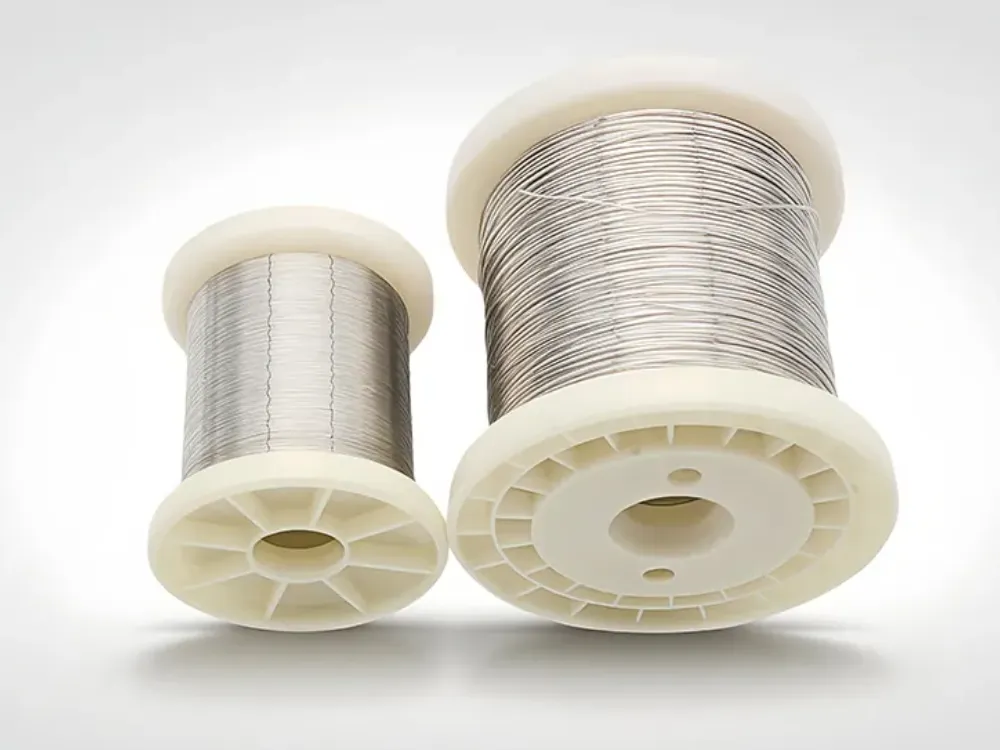
Start With Area and Units
For a uniform ideal rectangular section, use:
A = w × t
R20 = ρ20 × L / A
Here, A is area in mm², w and t are width and thickness in mm, L is length in metres, and ρ20 is resistivity in Ω mm²/m. The result R20 is resistance in ohms at the reference temperature of 20°C.
For nichrome ribbon, keep the length unit consistent with the resistivity unit. Mixing millimetres and metres can produce a large error even when the arithmetic is otherwise correct. State whether the length is the active heating length or the full conductor between test points.
For nichrome ribbon with a rounded edge profile, the rectangle is an approximation. Use measured resistance or a supplier table when the nominal-area model is too coarse for the acceptance requirement. Connections and measurement boundaries also need a clear definition.
Illustrative Scenario: One Metre of Flat Material
Consider an ideal rectangular sample with a width of 2.0 mm, thickness of 0.20 mm and length of 1.0 m. Use the Nikrothal 80 reference resistivity above solely to demonstrate the calculation. The dimensions are hypothetical, not a qualified SPARK stock size.
| Calculation Step | Result |
|---|---|
| Area: 2.0 × 0.20 | 0.40 mm² |
| Cold resistance: 1.09 × 1.0 / 0.40 | 2.725 Ω |
| Reference hot resistance: 2.725 × 1.05 | About 2.861 Ω |
The final row uses the source’s factor at 1000°C. It shows a resistance correction; it does not show that applying a particular voltage will bring the sample to 1000°C. The example has not defined cooling, supports, terminals or surrounding temperatures.
Do not add extra decimal places to imply a tighter material tolerance. The ideal calculation gives a reference value. An order needs an agreed acceptance range and test method.
Move From Resistance to Power Carefully
For a resistive element, electrical power can be expressed as P = V²/R or P = I²R, with the appropriate resistance for the condition being considered. These equations connect voltage, current and power. They do not provide a complete temperature model.
The University of Illinois explanation of a nichrome thermometer makes the distinction clear: heat transfer and surroundings affect temperature. It also notes the need for calibration when using resistance as a temperature indicator.
A nichrome ribbon calculation should therefore have a stated purpose. Are you checking cold resistance, estimating a hot electrical load, or reviewing a complete heater? Keep those tasks distinct, and use the resistance calculation guide for the broader electrical method.
Compare Ribbon and Round Wire on Equal Terms
Equal Area Is a Useful Starting Point
For the same uniform material, length and temperature, equal cross-sectional areas give equal ideal resistance in the simple model. A flat section does not acquire a different resistivity because its shape changed. The shape matters through geometry and the way the element works in the assembly.
For example, the hypothetical 0.40 mm² section above has an equal-area round diameter of about 0.714 mm, calculated from d = √(4A/π). This comparison holds area constant. It is not a recommendation to replace one shape with the other.
Check Exposed Surface and Support Contact
The ideal rectangular perimeter is 2(w + t). The round perimeter is πd. Multiplying those perimeters by length gives a simple geometric lateral surface estimate, before allowing for support contact and ends.
A broader surface can change the design options, but it does not establish a universal heat-up advantage. The amount of metal, surrounding heat transfer, support arrangement and electrical input all matter. Compare those conditions before claiming that nichrome ribbon will run cooler or respond faster.
Avoid comparing a wide thin ribbon with a round wire of unrelated area and then crediting every difference to shape. First state what has been held constant. Then explain what the geometry changes in the actual assembly.
Review the Installed Layout
A nichrome ribbon replacement must fit more than the electrical calculation. Check available space, run spacing, support contact, movement during heating and terminal geometry. A change in section may require a revised mounting arrangement even when the cold resistance matches.
The heating-coil selection guide covers the wider element-layout task. For the flat section, retain a clear drawing of the flat section and its orientation instead of treating it as a round coil with a different name.
Match the Flat Form to the Application
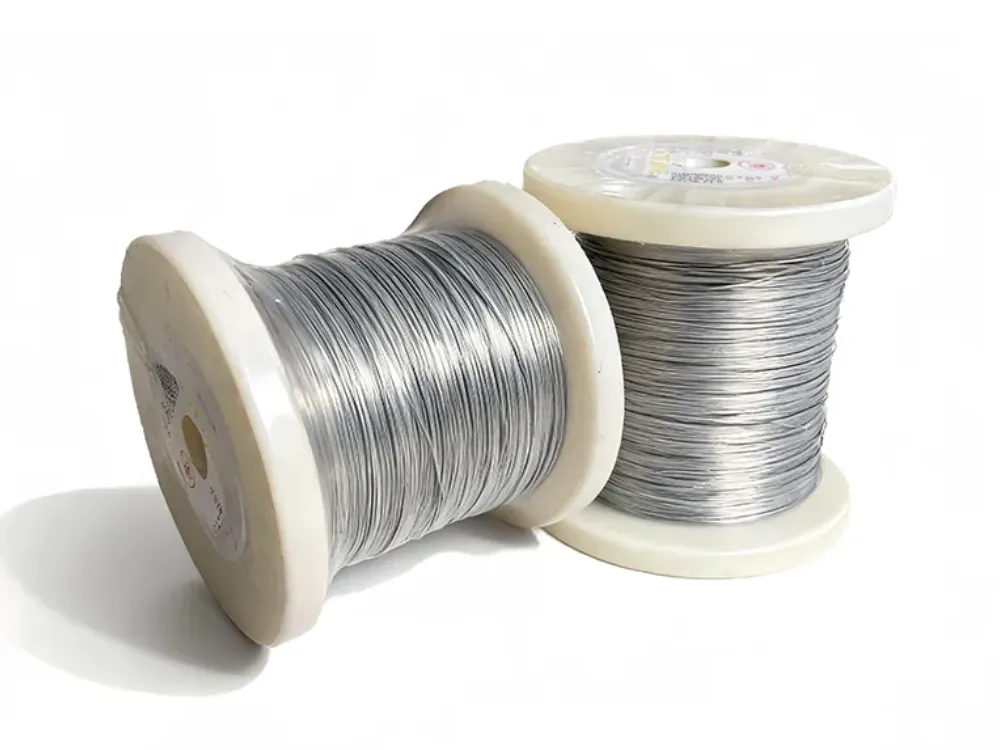
Furnace Elements and Resistance Components
The Nikrothal 80 strip datasheet names industrial furnace heating elements and braking resistors among its applications. This supports the use of flat resistance material in those fields. It does not prove that any width and thickness will suit a given assembly.
For a furnace enquiry, include the atmosphere and temperature cycle as well as the drawing. For a resistor enquiry, define the electrical duty and cooling conditions. Nichrome ribbon is a material form; the application determines which further design checks are needed.
Ask What the Assembly Requires
An existing nichrome ribbon heater drawing can be a useful starting point. Confirm whether it describes the original material, a later replacement, or a proposed redesign. Keep the equipment identification and drawing revision with the enquiry so those versions do not become mixed.
A supplier can then quote against a clear requirement. If some information is missing, mark it as unknown and identify who will confirm it. An honest gap is easier to resolve than a guessed temperature or an assumed alloy match.
Build a Complete Nichrome Ribbon Specification
Define What Will Be Supplied
A useful nichrome ribbon specification links a material designation to a measurable section and electrical requirement. Record both nominal values and the required acceptance ranges. Avoid asking a supplier to infer a tolerance from the number of decimal places on a drawing.
| Specification Field | Information to Provide |
|---|---|
| Material | Requested grade, composition reference and supply condition |
| Section | Width × thickness, units, tolerances and edge profile |
| Electrical requirement | Resistance per length or total resistance, reference temperature and tolerance |
| Length | Active length, full length and test-point boundaries |
| Assembly | Drawing, support arrangement, orientation and terminal detail |
| Service | Element temperature, atmosphere, cycling and cooling conditions |
| Supply | Voltage, current or control information relevant to the design |
| Acceptance | Test method, identification and required supporting documents |
For nichrome ribbon, a resistance specification can be more useful than nominal dimensions alone. Agree how it will be checked and what conductor length the value covers. That makes the requirement usable by purchasing, production and inspection.
Illustrative Scenario: Similar Sections, Different Requirements
An engineer compares two hypothetical flat sections with equal area. The calculation gives the same ideal resistance for equal lengths of the same alloy. One section is wider and thinner, so the engineer also reviews the drawing and support contact.
The engineer keeps the electrical target but asks for a separate layout review. No claim is made about which option lasts longer. The example shows why an equal resistance does not finish the selection process.
Close the Gaps Before Ordering
For a nichrome ribbon order, separate confirmed information from open questions. Ask the supplier to confirm the offered grade, section, resistance range and supply condition. Ask the assembly designer to confirm the mounting, connections and service limits.
If a substitution is proposed, compare it against those fields rather than accepting a trade-name resemblance. Keep the source data with the revised drawing. This provides a traceable basis for approval without inventing a universal equivalence rule.
For a nichrome ribbon requirement, contact SPARK with the completed specification. Availability, dimensions, documents and supply terms need confirmation for the actual enquiry.
Common Questions About Flat Heating Material
Can I Replace Round Wire With Ribbon?
Possibly, but equal cold resistance is only one check. Review the material, area, layout, supports and connections. Treat the change as an assembly decision rather than a direct substitution based on shape alone.
Does a Wider Ribbon Have Lower Resistance?
In the ideal model, increasing width while holding thickness, length, material and temperature constant increases area and lowers resistance. If another variable changes too, calculate the full comparison. A width by itself does not define resistance.
Can I Find Temperature From Resistance?
Only with suitable material data, measurement boundaries and calibration for the intended use. The reading may include joints and sections at different temperatures. Do not turn a single cold resistance into a predicted operating temperature.
Can I Solder Nichrome Ribbon?
Do not select a joint method from the material name alone. Specify the service temperature, terminal materials and mechanical demands, then obtain an appropriate connection method from the assembly and material suppliers. This guide does not prescribe a solder or joining process.
What Should I Send With an Enquiry?
Send the alloy request, width, thickness, length and resistance target together with a drawing and service conditions. Mark unknowns clearly. That gives the supplier a practical starting point and helps prevent a nominal size from being mistaken for a complete requirement.
Selecting nichrome ribbon means connecting the material data to the real element. Start with a clear electrical target, check the geometry, and document the service conditions. Then send SPARK your specification and open questions so the available supply options can be confirmed.